Optical Choppers

Optical choppers are used to interrupt a continuous light beam, creating pulses with a consistent frequency. This is often used to isolate a small signal.

X

Product Category

View Filter

x
Clear all x

Filter Option


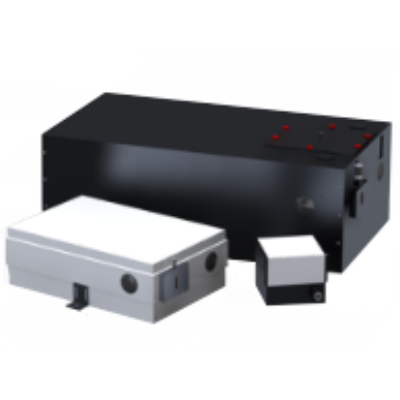
The Sciencetech Polarizing variable frequency optical chopper is used with the detectors during Martin-Puplett mode. The chopper is positioned in front of the output port, and captures the output at 45 degrees from the two planes of polarization. This facilitates the retrieval of the Fourier Transform Interferogram during M-P mode. The chopper itself is designed for high stability and a broad range of frequency control (from 0.5Hz to 100Hz). The price includes the servo motor and software controller.
4,957.00 4957.0 USD

Price Valid only in North America


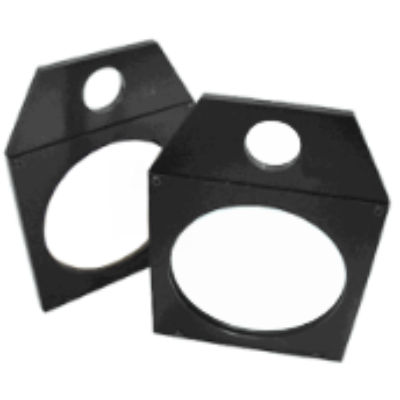
This rotating-blade chopper has a 1" diameter opening on one face and a 2" diameter opening on the opposite face. The blade is positioned closest to the 1" face. Either opening can be used as the input or output, depending on the configuration of your system.
This chopper is usually used in cases where a converging beam enters the chopper housing from a 2" optical tube and then is coupled to a monochromator. In this case, the 2" opening is coupled to the lamp housing and the 1" opening is coupled to the monochromator input. It could be used in the reverse orientation for a diverging beam.
For collimated inputs, this chopper accepts a maximum 1" diameter beam, but the CH-MC-E-1D1D chopper is usually used for this application instead.

The 1" face has a 1-D slip ring with H4 hole pattern.
The 2" face has a 2-D slip ring with S4 hole pattern.
This system includes a 2-slot blade for frequency range of 4-200 Hz. Higher frequency ranges are available with other blades.
Includes enclosure and driver.
This chopper is compatible with SciSpec and SciPV software.
For integration into Sciencetech instruments or larger integrated systems, see SciencetechCOM and SciAX software.
Third party control software is included with this chopper but is not supported by Sciencetech.

In Stock
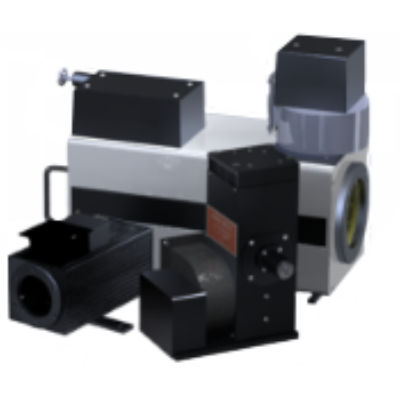
This rotating-blade chopper has a 1" diameter opening on one face and a 2" diameter opening on the opposite face. The blade is positioned closest to the 1" face. Either opening can be used as the input or output, depending on the configuration of your system.
This chopper is usually used in cases where a converging beam enters the chopper housing from a 2" optical tube and then is coupled to a monochromator. In this case, the 2" opening is coupled to the lamp housing and the 1" opening is coupled to the monochromator input. It could be used in the reverse orientation for a diverging beam.
For collimated inputs, this chopper accepts a maximum 1" diameter beam, but the CH-MC-E-1D1D chopper is usually used for this application instead.

The 1" face has a 1-D slip ring with H4 hole pattern.
The 2" face has a 2-D slip ring with S4 hole pattern.
This system includes a 2-slot blade for frequency range of 4-200 Hz. Higher frequency ranges are available with other blades.
Includes enclosure and driver.
This chopper is compatible with SciSpec and SciPV software.
For integration into Sciencetech instruments or larger integrated systems, see SciencetechCOM and SciAX software.
Third party control software is included with this chopper but is not supported by Sciencetech.
3,130.00 3130.0 USD

Price Valid only in North America
Copyright © Sciencetech